Aberlour Children’s Charity began as an orphanage in 1875, founded by Canon Charles Jupp in Aberlour, Scotland. Originally established to care for “mitherless bairns,” the orphanage grew into one of Scotland’s largest children’s institutions, housing up to 500 children at its peak. Over time, the charity evolved, shifting from large-scale residential care to more tailored support services for vulnerable children, young people, and families across Scotland.
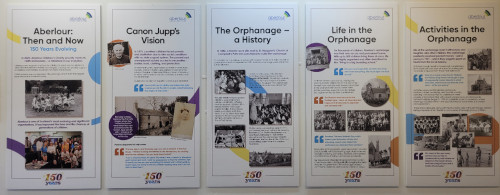
Exhibition panels on the University Library walls.
The archive of the Trust, dating right back to the foundation of Aberlour Orphanage, was transferred to the University of Stirling in 2021 as part of a research project between the University of Stirling and the University of Osnabrück entitled ‘Back to the Future: Archiving Residential Children’s Homes’ (ARCH). This research project was supported by the Arts and Humanities Council and the German Research Foundation (Deutsche Forschungsgemeinschaft DFG) and aimed to explore and improve how the everyday group care experiences of children and young people in residential care are captured and preserved. To fully explore the possibilities, the project team worked in active partnership with young people and care experienced adults as well as using the Aberlour Archive as an example of the kinds of records which have historically been created, kept and made available to those who are care experienced.
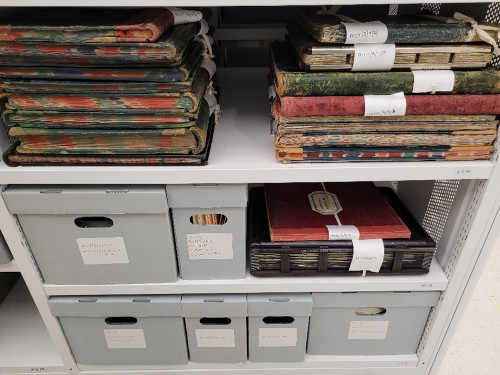
Part of the Aberlour Children’s Charity Archive in our stores.
The cataloguing of the collection was made possible through the ‘Archives Revealed’ funding scheme, which was jointly awarded by The National Archives, The Pilgrim Trust and the Wolfson Foundation in 2021 and allows archive services to make significant collections accessible that otherwise would be difficult to catalogue using existing resources. After two fantastic Project Archivists, Jenny and Jennifer, had sorted, conserved and created a full catalogue for the archive, it was launched officially in 2022 with the donation of the personal collection of a former resident of the orphanage.
During this project we were also able to digitise sets of key historical records in the collection to support research. These records can be found embedded in our online catalogue, including files in the photograph series which contain a striking visual record of Aberlour and issues of the subscriber publication Aberlour Orphanage Magazine, rich in detail and notorious for being rose-tinted despite its blue colour, earning it the nickname ‘the little blue book of lies’ among the children!
In 2025, this incredible organisation proudly celebrates its 150th anniversary and the University Archive and Special Collections is supporting a range of activities and events planned by Aberlour throughout the year. It has been wonderful to support the present day charity in using the archive to tell the story of Aberlour and the tens of thousands of children and young people who have been supported by the organisation in its long history.
Key among the anniversary celebrations is an exhibition entitled ‘Aberlour: Now and Then’ which opened at the Strathspey Visitor Centre in Aberlour. Combining historic photographs and unique and striking objects from the archive – including the original clock from the orphanage in Aberlour – the exhibition speaks to the rich history of the institution and hints at its role in providing records for care experienced people with which they can evidence their lives and relate their childhood.
The exhibition closed at Strathspey and is now open to all in the University of Stirling Library until 31st August 2025. For a sneak preview of material on display, you can watch a video of Aberlour staff visiting the archive to conduct some research for their anniversary celebrations.
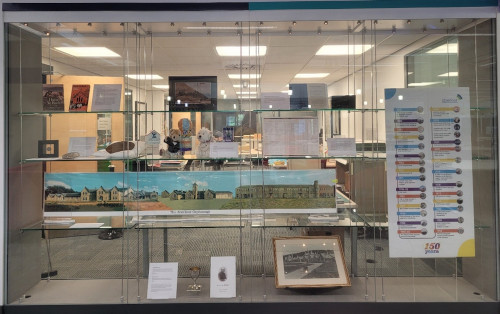
Some of the wonderful items from the archive on display in the University Library, chosen by Aberlour staff to tell their story.
Rosie Al-Mulla Taylor Assistant Archivist University of Stirling Archives & Special Collections
2025 marks 200 years of technical and professional education in Huddersfield, celebrating the establishment of Huddersfield’s Scientific and Mechanic Institute in 1825. This organisation was set up to bring the “acquisition of useful knowledge” within the reach of all, particularly the trading and working classes. Whilst our institution was not founded in 1825 (the University’s oldest predecessor dates back to 1841), Heritage Quay, as the holder of the University archives, is well placed to help tell the broader story.
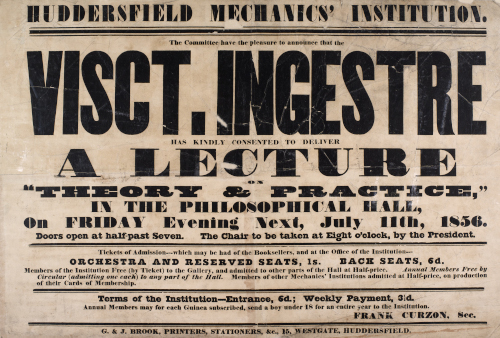
Poster advertising classes at the Huddersfield Mechanics Institute, a predecessor of the University.
Whenever there is a significant anniversary related to the University the archive team are usually involved. For the University’s 175th birthday in 2016 one of the team worked with the Vice-Chancellors Office and academic researchers to support the production of reference materials, tours and a pop-up exhibition. We worked on a printed trail of campus, and timeline. Whilst our contribution was significant, it was supplementary to the rest of the activities.
2025 project
This time we are taking the lead through a new exhibition ‘The Town that Taught Itself’, which tells the story of the University, its predecessors, and the connection with the people of Huddersfield. This article will explore the approach we have taken and the impact of the work.
Broadly, we have used allocated exhibition development time to go back to the archives and conduct new research in aid of telling a richer and more diverse story about our origins. This has taken a few forms; we have confirmed every key institutional date with a link to the appropriate place in the catalogue, undertaken archival research and conducted a location audit of the main University collection (which is around 1,100 boxes).
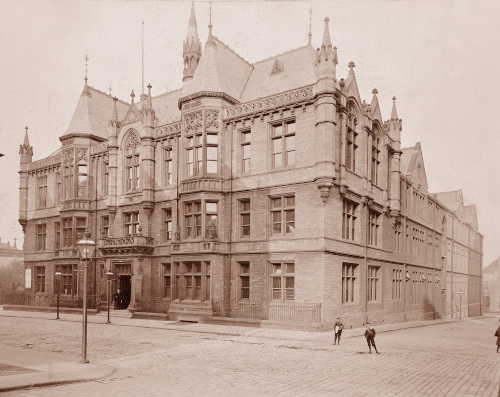
The Ramsden Building, the first space that the University built on its Queensgate campus in the 1880s.
Exhibition development
The curator’s approach to exhibition development has not merely been to provide a synthesis of previous histories, illustrated with archival documents, but instead to produce new research.
There are three notable examples:
They have identified the names of the five original founders of the University for the first time using archival collections, secondary sources and digitised census returns. Previously histories of the institution have focussed on their benefactor Frederick Schwann but for the first time the real people behind the story have been put in the spotlight. You can read more about that here.
The exhibition will feature a map of around 30 locations across Huddersfield which the University and its predecessors have used since 1841, highlighting the importance of the institution to the town.
The exhibition acknowledges all of the University’s predecessor organisations. Research time has been dedicated to investigating the relationships between the six organisations identified as merging to form the University across a 110-year period. These connections have been clarified, and in some cases, celebrated properly for the first time.
Placements
Underpinning the project is the contributions of two placement students: one from the University (who undertook the locations audit) and one external. The external placement, which was for 16 weeks, was particularly essential to the success of the project as they were able to spend significant time researching and confirming facts and details of the University’s history and flagging them for the exhibition. You can read more about the student’s experience here.
External Placement Student George who undertook research into the University’s administrative history.
Impact
As the year has developed, the University has looked to the archive service for material for news stories, for general information and for support relating to the history of the University. The effect of this has been to place the archive and the collections at the heart of the programme. The exhibition will be signposted during graduation and in the 2025/6 welcome week for new students in September, which will raise our profile internally.
The original research has resulted in a Zooniverse project which will improve knowledge about the collection and the University’s history. This project would not have been initiated without the curator’s research. The outcome of this will be that the catalogue will be more accessible and representative of the collections.
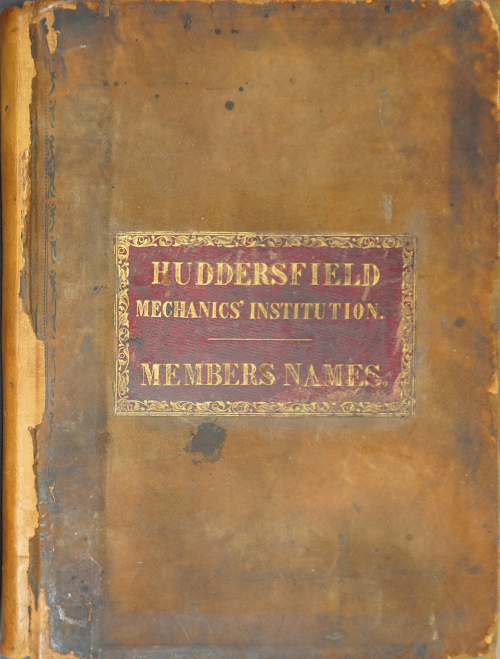
Front cover of 1884 Members Book for the Huddersfield Mechanics Institute (HUD/SR/1).
These are all positives, but the resources dedicated to the project have had an impact on the service. Before the project began, there was an acknowledgement that significant resources would be required for it to be rigorous and of sufficient quality. The use of a placement student to underpin the historical research and catalogue development was thus a key requirement; but the service also made the decision that the exhibition curator’s time would be dedicated to the project, reducing capacity in other areas. The subsequent impacts and the benefits to the service will be a useful model as we work with the Students’ Union on their centenary in 2027.
Research for the exhibition will be used to improve catalogue data on our online catalogue. In the future, this information will also be exported to Archives Hub to reach more researchers.
The Town that Taught Itself
The exhibition opened to the public on Tuesday 27 May and will be on display until the end of September. Find out more about how to visit.
Dave Smith, Public Engagement Officer Heritage Quay University of Huddersfield
Related
Collection descriptions on Archives Hub related to the University’s history or archives:
The Stationers Company started out as a ‘mystery’, or craft association, in 1403. This was late for a traditional City company, reflecting the relatively lowly status of the Stationers’ trades: scribes, limners and book-binders were considerably less essential to the economy than workers of metal and leather, or provisioners of meat and salt. By the end of the century, however, the Stationers’ fortunes had been transformed by an unforeseen turn of events: Caxton’s introduction of the printing-press to England.
The print revolution meant that ideas could be disseminated at an unprecedented rate, and its political implications were not lost on the authorities. In 1557, Mary Tudor, anxious to shore up her precarious reign, granted the Stationers a royal charter of incorporation which not only allowed them the civic privileges enjoyed by other Livery Companies, but also awarded them extraordinary control over English print.
Leaf of the Inspeximus Exemplification of Charter of Incorporation issued at the request of Charles II, 1667. The Company’s copy of its original Charter has been lost. Stationers’ Company Archive, TSC/A/01/01/02
Integral to the Stationers’ policing of the printing trade was the maintenance of a register, listing all titles officially licensed for publication, alongside the name of the publisher and date of publication. This established the publisher’s right to print (or ‘copy’) a work, and is often cited as an early version of copyright. It also commodified that right, which could be sold, transferred or inherited. Spanning several volumes and nearly four centuries, the Stationers’ Register has survived to provide us with an unparalleled record of early English print culture. Here we look at a selection of entries to understand how concepts of naming, anonymity and authorship developed over time.
This first example shows the entry of copy of the first printed work which we know to be written by Shakespeare. This is the long poem Venus and Adonis, registered in 1593, while London theatres were closed due to an outbreak of bubonic plague. Significantly, Shakespeare’s name does not appear in the entry. At this period, the writer of a literary work was a relatively minor player in its production, selling the title to the publisher for a one-off fee. From then on, it was entirely the property of the publisher (in this case Richard Field) with whose name the work was linked.
Venus and Adonis entered for Richard Field, 18 April 1593. Stationers’ Company Archive, TSC/F/01/01
While the Stationers’ Register secured the publisher’s financial interests in a work, it also fulfilled the surveillance role envisioned by Mary Tudor and her successors. This crossed-out entry is a case in point. William Prynne’s Histriomastix, a turgid diatribe against Restoration theatre, was originally registered in 1630. However, Prynne didn’t send it to press until late 1632, timing his virulent attack on female actors to coincide with the stage debut of Charles I’s consort, Henrietta Maria. Not noted for his sense of humour, Charles responded by having Prynne fined, pilloried, imprisoned and mutilated. Joining him on the pillory was the publisher named in the Register, Michael Sparke, who was also heavily fined and suspended from the Livery of the Stationers’ Company. And, as the Register shows, the license for publication was firmly withdrawn.
Histriomastix by William Prynne, entered for Michael Sparkes, 16 October 1630. Stationers’ Company Archive, TSC/E/06/03
By the end of the seventeenth century, political changes removed the legal obligation to register publications with the Stationers’ Company. Entry in the Stationers’ Register still offered legal protection from plagiarism, however, and possibly also reputational gain. The Interesting Narrative of the Life of Olaudah Equiano, Or Gustavus Vassa, The African was registered at Stationers’ Hall on its first publication in 1789. Olaudah Equiano (c. 1745–1797) was born in west Africa, the son of an Igbo dignitary. At the age of eight he was kidnapped by slave raiders, and subsequently enslaved several times before he managed to buy his emancipation. In the late 1760s he came to London, where he campaigned for the abolition of slavery, and for fairer conditions for London’s Black community.
The Interesting Narrative of the Life of Olaudah Equiano, Or Gustavus Vassa, The African, entered for the author, 25 March 1789. Stationers’ Company Archive, TSC/E/06/11
Equiano’s use of two names in his authoring of the book is significant. In the book, he explains that Gustavus Vassa was the name given to him by his ‘captain and master’ on board the slave ship that first carried him to England. But he also recounts that as a child he was named ‘Olaudah, which in our language, signifies vicissitude or fortune, also, one favoured, and having a loud voice and well spoken’. Reclaiming that name is part of reclaiming his identity and dignity from the dehumanising narrative enacted by enslavement.
Frankenstein, or, The Modern Prometheus, entered for Lackington & Company, 15 January 1818. Stationers’ Company Archive, TSC/E/06/18
Our last entry from the Stationers’ Register is for another seminal work: Frankenstein, or, The Modern Prometheus, registered on 15 January 1818. One of the most influential works of literature in the English language, spawning numerous adaptations and re-imaginings in every medium and genre (including over sixty films), the book was originally published anonymously. This was not unusual for novels at the time, particularly those written by women, whose work faced an additional level of critical hostility. An early review of Frankenstein typifies the prevailing attitude: ‘We need scarcely say, that these volumes have neither principle, object, nor moral… The writer of it is, we understand, a female; this is an aggravation of that which is the prevailing fault of the novel; but if our authoress can forget the gentleness of her sex, it is no reason why we should; and we shall therefore dismiss the novel without further comment.’ (British Critic: And Quarterly Theological Review, ser.2 v.09 yr.1818. London: Printed for F. and C. Rivington, digitised by the Hathi Trust and accessed at https://hdl.handle.net/2027/uc1.aa0001508613). Ironically, the subsequent disclosure of Mary Shelley’s authorship was greeted with disbelief by other critics, who refused to accept that this young woman was capable of writing such an imaginative and well-executed book.
Volumes of the Stationers’ Register for the years 1554 to 1842 are held at the Stationers’ Company Archive, alongside a wealth of other records bringing print history – and London’s history – to life. Records can be consulted at the Tokefield Centre, the Company’s dedicated archive centre. For more information on our collection, and on how to access the Stationers’ Company Archive, visit our website and our online catalogue.
Dr Ruth Frendo, Archivist The Worshipful Company of Stationers and Newspaper Makers
“It’s only when one is obliged to ask oneself quite fresh questions about what one is doing, that one really starts to learn.” Reginald Revans
Action learning is an approach to problem solving which continues today to be an effective and well-used method. Rather than prioritising ‘expert knowledge’ handed down from higher-ups, the action learning approach values knowledge exchange, asking questions, and reflection.
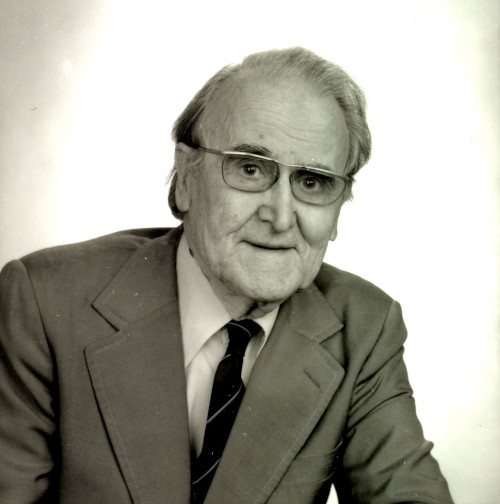
Reginald Revans (1907-2003) pioneered the action learning movement and continued to preach its values, travelling and lecturing far into his old age. Although it has had lasting power, action learning wasn’t met with praise at the time of its conception, when business minds in the UK looked up to academic principles and expert knowledge. In this environment, Revans’ idea of a meeting of minds across the business hierarchy wasn’t highly favoured. However, his ideas endure and today the principles of action learning are used in the fields of business, industry, education, social work and many more.
The University of Salford archives holds The Revans Collection for Action Learning, a wide collection of materials about Revans, including his published books, personal papers and correspondence. The full catalogue for this collection can be found online. Among the collection are dozens of large flipcharts which Revans himself drew and used during lectures and meetings to display his data and figures. These flipcharts have recently been digitised and are now available on Salford Digital Archives.
Archive image of Reginald Revans, pioneer of the Action Learning movement.
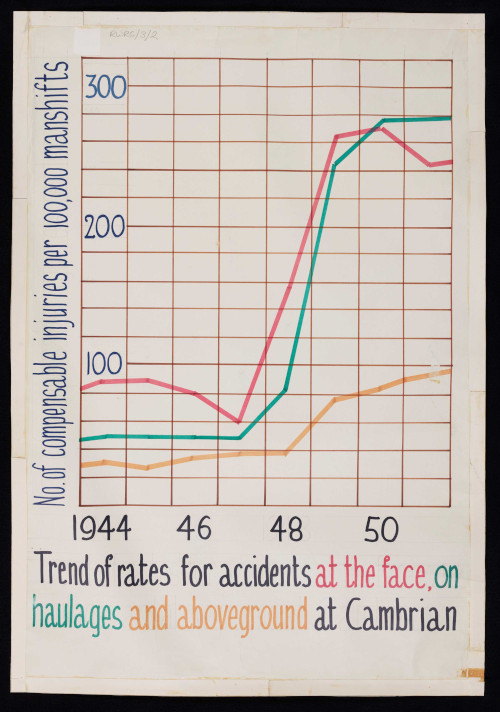
The flipcharts take us on a journey through the many sectors Revans applied action learning to, beginning with the coal mining industry in the late 1940s. Revans was the Director of Education for the National Coal Board, and this is where he developed the theory of action learning. Rather than holing up in boardrooms having meetings, Revans wanted to get first-hand experience and knowledge from the miners and chose to begin his work at the coalface instead.
Revans encouraged pitworkers and managers to interface together and learn from each other’s experiences. He tracked trends in figures such as wages costs, number of accidents, and tonnage per man lost in disputes. But we can see from the collection that he was also interested in more qualitative data, such as responses of coal miners to different types of task structures or working group sizes. Pits that adopted an action learning approach were able to boost their productivity by up to 30%.
Digitised graph showing rates of accidents and compensable injuries at Cambrian coalmine.
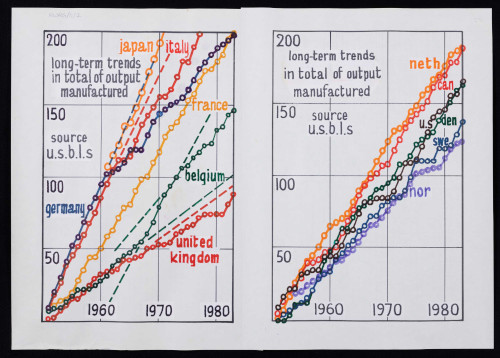
The next stop in Revans’ career takes us across to Belgium, where he headed up the Inter-University Programme. This was a project to increase Belgium’s economic productivity, which was low at the time. Revans worked with major universities and corporations to adopt an action learning approach to economics which majorly boosted the nation’s economy. Revans was later honoured by the King of Belgium for his efforts. During this project, the flipcharts become incredibly detailed and meticulous. As he tracks the economic progress of several countries, we can see his artistic side shining through in these colourful displays of data.
Digitised graphs showing manufacturing trends from the 1950s to the 1980s in various countries.
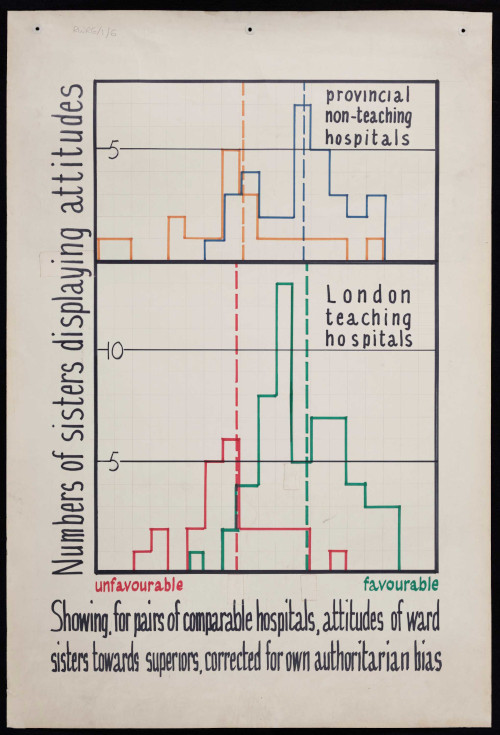
The Hospitals Internal Communications Programme saw Revans bring action learning theories into hospitals in London to improve both patient and staff experience. Like in the mines, Revans looked at numbers and figures, as well as opinions and feelings, to gather the data he needed. The collection includes graphs tracking trends such as ward sisters’ attitudes, length of patient stays and volunteer management.
Digitised bar chart showing attitudes of ward sisters in different types of hospitals.
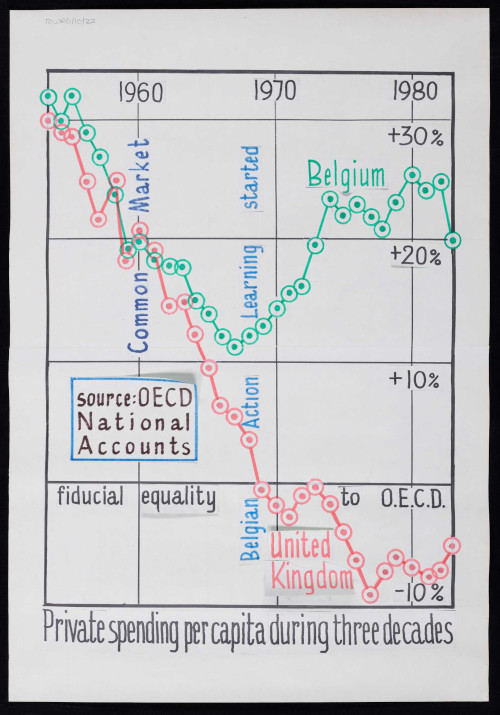
The collection also contains two videos of Revans being interviewed at 83 years old about action learning. We presume, due to the presence of a cat in his lap, that the interview takes place in his own home. Revans talks through the basic principles of action learning and uses some of his flipcharts (including the one below) to show how he has applied it in various fields. His quick wit and sense of humour can be seen in these videos, showing a personal side to a great academic mind.
Digitised graph comparing private spending per capita in Belgium and the UK from the 1950s to the 1980s.
Through The Revans Collection for Action Learning, we can gain an insight into the work and personality of Reginald Revans. The data alone shows the improvements to efficiency he was able to implement in several different fields, however the drawings themselves also show us a lot. His artistic nature is revealed through the diligently hand-drawn, consistent graphs and tables, which contain such detail. In a time where we can produce a visualisation of data at the click of a button, it’s hard to imagine the time Revans must have spent on them, showing his real passion and dedication to his model of action learning.
On its shelves can be found a rich assortment of documents, photographs, drawings, maps and plans that primarily document British-led archaeological projects from World War II onwards. These include excavations at Hellenistic and Roman sites in Libya like Euesperides (Benghazi), Sidi Khrebish (Berenice), Cyrene, Lepcis Magna, and Sabratha. The archive also holds valuable material from ground-breaking multi-disciplinary surveys in the pre-desert valleys of Tripolitania and the Saharan oases of Fazzan, as well as excavations at Islamic Barca (El Merj) and Medinet Sultan.
The British Institute for Libyan and Northern African Studies [BILNAS] Archive, University of Leicester.
To mark International Women’s Day, BILNAS is celebrating two influential archaeologists whose important work in North Africa forms part of its archive: Dame Kathleen Kenyon and Lady Olwen Brogan.
Dame Kathleen Kenyon
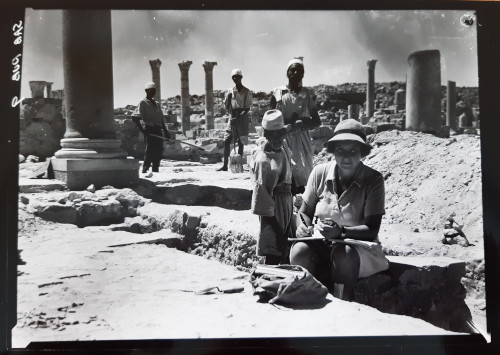
BILNAS/D5/12/7/8, Kathleen Kenyon and unidentified men at the basilica, Sabratha (1949-1951). The Kathleen Kenyon and John Ward Perkins Papers on Sabratha (1932 – 1992). The British Institute for Libyan and Northern African Studies [BILNAS] Archive.
Dame Kathleen Mary Kenyon (b. 1906 – d. 1978), was a leading British archaeologist known for her significant work at Jericho (Tell es-Sultan) and the Jewry Wall in Leicester, as well as her contribution to the development of excavation and recording techniques along with Sir Mortimer Wheeler.
The BILNAS Archive holds the records of Kenyon’s work at the site of Sabratha, a key Punic and Roman trading port on the Libyan Coast. There, alongside John Bryan Ward-Perkins, she refined stratigraphic excavation techniques to establish a chronological framework for the site.
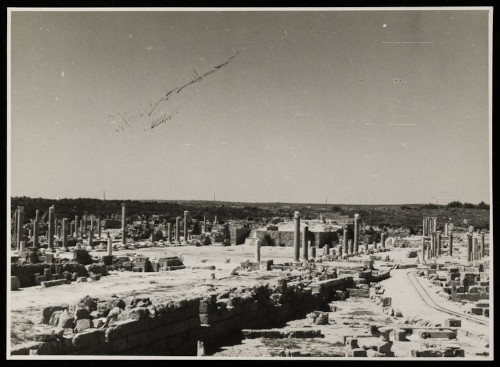
BILNAS/D5/12/1/14/2/18, Panoramic view of Sabratha (1949). The Kathleen Kenyon and John Ward Perkins Papers on Sabratha (1932 – 1992). The British Institute for Libyan and Northern African Studies [BILNAS] Archive.
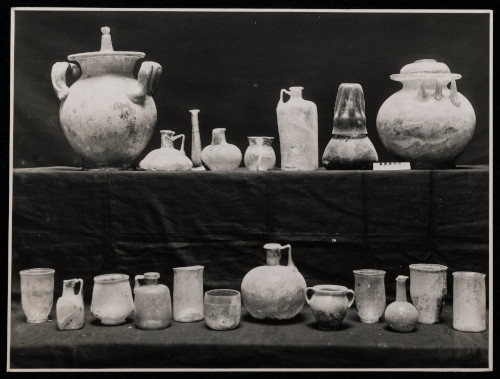
By developing a typology of pottery corresponding to different strata, Kenyon successfully reconstructed the site’s occupational history. This approach allowed her to trace the evolution of Sabratha’s central area, from its earliest Phoenician trading encampments to the emergence of a more permanent settlement around the fifth century B.C.E. This work not only demonstrated the effectiveness of stratigraphic dating but also provided a crucial training ground for students, many of whom had been unable to gain hands-on experience in the field since the 1930s.
BILNAS/D5/12/6/4/1, Photograph of pottery finds from Sabratha (1948-1951). The Kathleen Kenyon and John Ward Perkins Papers on Sabratha (1932 – 1992). The British Institute for Libyan and Northern African Studies [BILNAS] Archive.
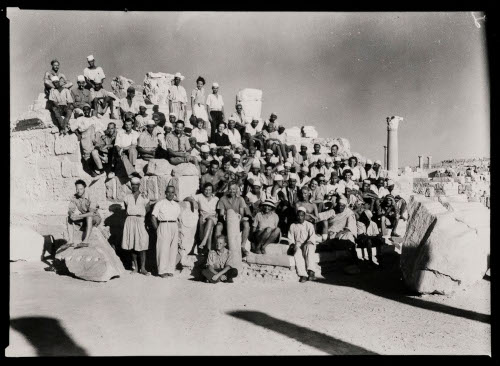
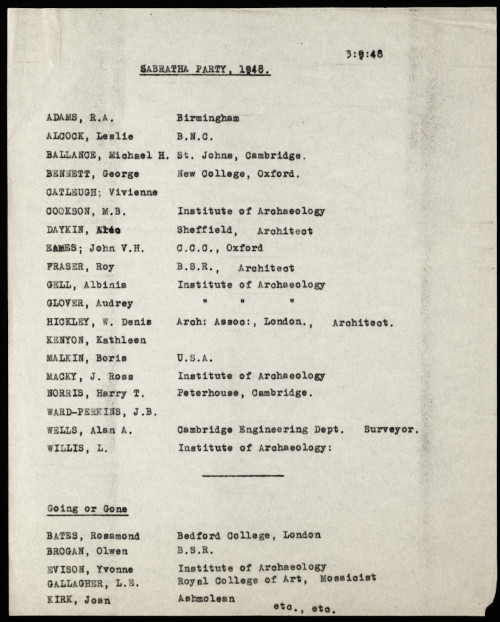
Kenyon was deeply committed to archaeological education, the training of women in particular, as reflected in the composition of the expedition team at Sabratha. Many of the 25 students working at the Sabratha site did so under Kenyon’s direct guidance, and would later work with her again in Jericho. Kenyon’s emphasis on rigorous training and stratigraphic methods was shared by her colleague Olwen Brogan, who worked alongside her at Sabratha.
BILNAS/D5/12/7/19, Photograph of the excavation team assembled (1949-1951). The Kathleen Kenyon and John Ward Perkins Collection. The British Institute for Libyan and Northern African Studies [BILNAS] Archive.
BILNAS/D5/3/1/1, List of personnel for Sabratha exhibition (1948). The Kathleen Kenyon and John Ward Perkins Papers on Sabratha (1932 – 1992). The British Institute for Libyan and Northern African Studies [BILNAS] Archive.
Lady Olwen Brogan
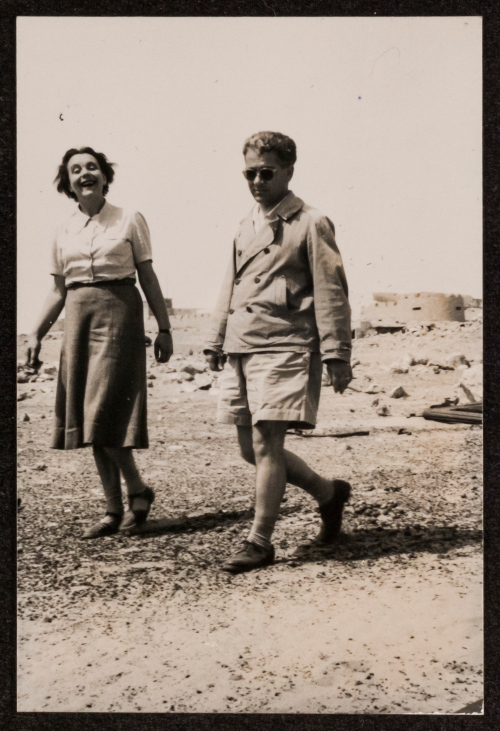
BILNAS/D41/2/7/2/58, Photograph of Olwen Brogan with Dr Vergara-Caffarelli at Ghirza (1950s-1970s). The Olwen Brogan Papers (19th cent-1989). The British Institute for Libyan and Northern African Studies [BILNAS] Archive.
Lady Olwen Phillis Frances Brogan (later Hackett) (b. 1900 – d. 1989), was a pioneering British archaeologist whose meticulous field work reshaped the study of classical sites in Libya. Renowned for her contributions to excavation methodology and historical interpretation, she played a pivotal role in documenting North Africa’s rich archaeological heritage. She was also instrumental in establishing and managing the Society for Libyan Studies (now BILNAS).
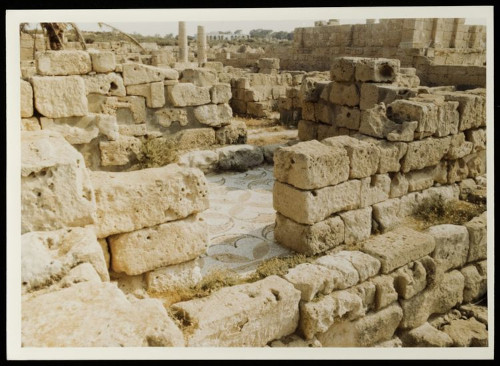
Brogan’s first expedition to North Africa was in 1948 with the British School at Rome. Under the direction of Kathleen Kenyon, she supervised the excavation of a residential block behind the East Forum Temple at Sabratha. Applying the stratigraphic techniques, she had learned under the direction of Sir Mortimer Wheeler at St. Albans (Verulamium) and alongside Kenyon – Brogan produced some of the most well-dated sequences on the site. The ‘Casa Brogan’, as it came to be known, remains one of the finest examples of meticulous excavation from its time, setting a benchmark for future excavations in the region.
BILNAS/D5/12/1/15/4, Photograph of mosaic flooring and wall at Casa Brogan, Sabratha (1984). The Kathleen Kenyon and John Ward Perkins Papers on Sabratha (1932 – 1992). The British Institute for Libyan and Northern African Studies [BILNAS] Archive.
Building on her work at Sabratha, Brogan returned to Libya in the 1950s, conducting work at the Roman city of Lepcis Magna alongside John Bryan Ward-Perkins. However, it was in the less-explored frontier regions of Tripolitania, rather than its great coastal cities, that Brogan would make her most enduring scholarly contribution.
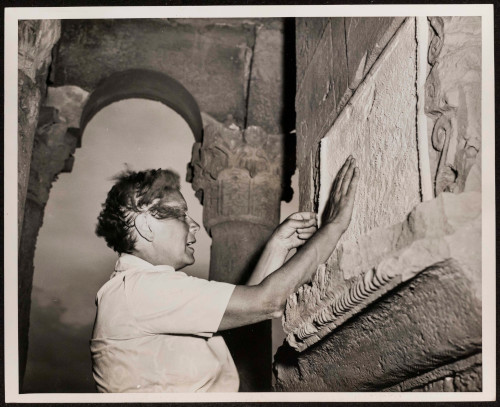
Shifting her focus to the pre-desert region in 1953, Brogan dedicated considerable time to surveying, excavating and documenting the Romano-Libyan settlement at Ghirza. Her meticulous stratigraphic work provided ground-breaking evidence that challenged prevailing scholarly assumptions. She successfully argued that Ghirza was a Libyan settlement during the Roman Period, identifying earlier phases of construction and emphasising the contribution of the local Libyan population in shaping this site. Her research continues to inform contemporary studies of Libya’s classical and indigenous heritage.
BILNAS/D41/2/7/8/3/2/46, Photograph of Olwen Brogan making a squeeze of inscription at Ghriza (1950s-1970s). The Olwen Brogan Papers (19th cent-1989). The British Institute for Libyan and Northern African Studies [BILNAS] Archive.
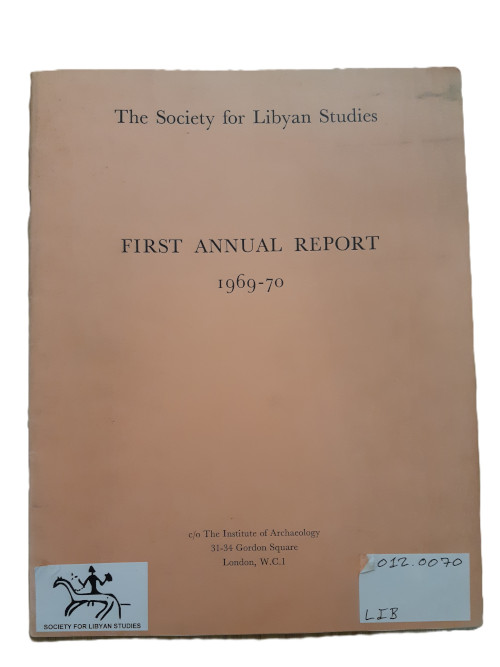
Throughout the 1960s, Brogan was instrumental in advocating for a society that would encourage and coordinate the work of British Scholars in Libya. Her efforts culminated in the establishment of the Society for Libyan Studies in 1969, where she served as its first Secretary. The Society’s mission was to ‘‘encourage, support and undertake the study of, and research relating to, the history, antiquities, cultural and natural history of Libya and fields connected therewith’. This commitment to fostering scholarship on Libya and the wider Northern African region continues today under the society’s new name, BILNAS.
BILNAS/D25/1, The Society for Libyan Studies, First Annual Report (1970). Libyan Studies – The Journal of BILNAS (1969 – 2011), The British Institute for Libyan and Northern African Studies [BILNAS] Archive.
Exploring the Archives
The BILNAS Archive is located within the School of Archaeology and Ancient History, at the University of Leicester. To access physical collections, please contact the BILNAS Archivist, Dr Anne Marie Williamson, at [email protected]. You can explore the archive catalogue via the University of Leicester here.
Digitised Collections
Kenyon’s Sabratha papers are now available online and open-access through the Archaeology Data Service, making these invaluable resources accessible not only to UK researchers, but also North African heritage professionals, academics, students and anyone interested in the region’s rich history. Brogan’s papers from Ghirza will be added to the online collection soon, and the digitisation of further collections is underway.
Stay Connected
Stay updated on news and events by visiting our website here.
Dr Anne Marie Williamson, Archivist British Institute for Libyan and Northern African Studies School of Archaeology and Ancient History University of Leicester
All images copyright The British Institute for Libyan and Northern African Studies [BILNAS] Archive, except the first image which is copyright University of Leicester. Reproduced with the kind permission of the copyright holders.
Next month, on March 8th – we celebrate International Women’s Day and to celebrate that we’ll be exploring how our archive informed us of the lack of female representation in our collection, and how we, at Ffotogallery, have used that information to make informed decisions going forward.
In April 2024, Ffotogallery appointed its first Archive Project Officer, and with the help of volunteers and local archivists – began to catalogue and digitise the gallery’s archive collection to make the history of Ffotogallery available via an online catalogue. None of this could have been possible without the generous funding from The National Lottery Heritage fund.
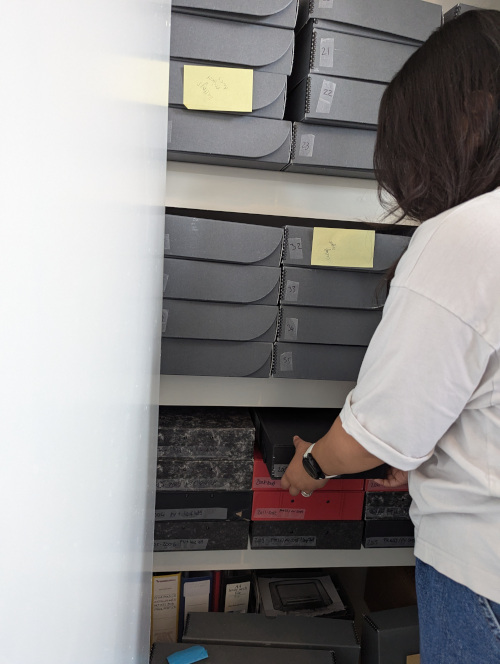
One of our cabinets, storing exhibition marketing materials, press clippings and paperwork, August 2024. Reproduction of copyrighted works is not permitted.
This digitisation project has allowed us to explore deep into our collections, something we did not have the resources to do before receiving the funding. It allowed us to look into the entire archive that Ffotogallery holds with material from Ffotogallery’s conception in 1978 to today, uncovering new information and details about Ffotogallery’s history, its relationship with photographers and its legacy.
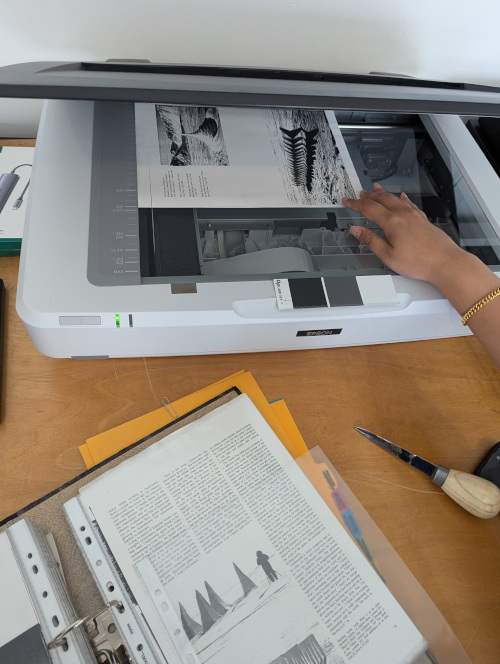
Our student intern Amira scanning in press clippings, August 2024. Reproduction of copyrighted works is not permitted.
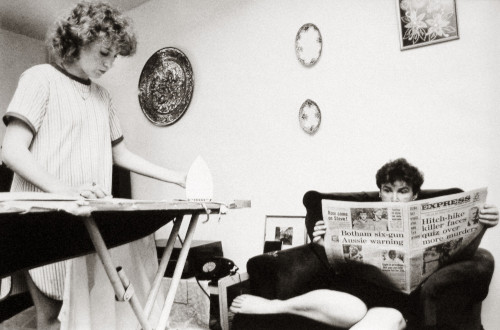
For the first time, The Valleys Project archive – a collection of over 400 photographs documenting the South Wales Valleys over five years (1985-1990) has been presented in the form of an online catalogue and can be viewed, in its entirety, all in one place. The Valleys Project collection has been available to view via in-person appointments to the Ffotogallery archive but now the public can access the full collection online for the first time since its conception in 1985.
The first issue we identified was how only one female photographer, Francesca Odell, was commissioned as part of the Valley Project over those five years, in comparison to the nine male photographers who were also commissioned as part of this project.
We then went through the number of female photographers and male photographers who have been exhibited at Ffotogallery since 1978, the lack of female photographers that had been exhibited was visibly noticeable.
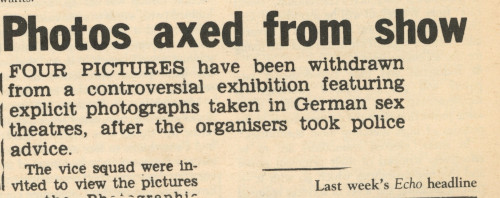
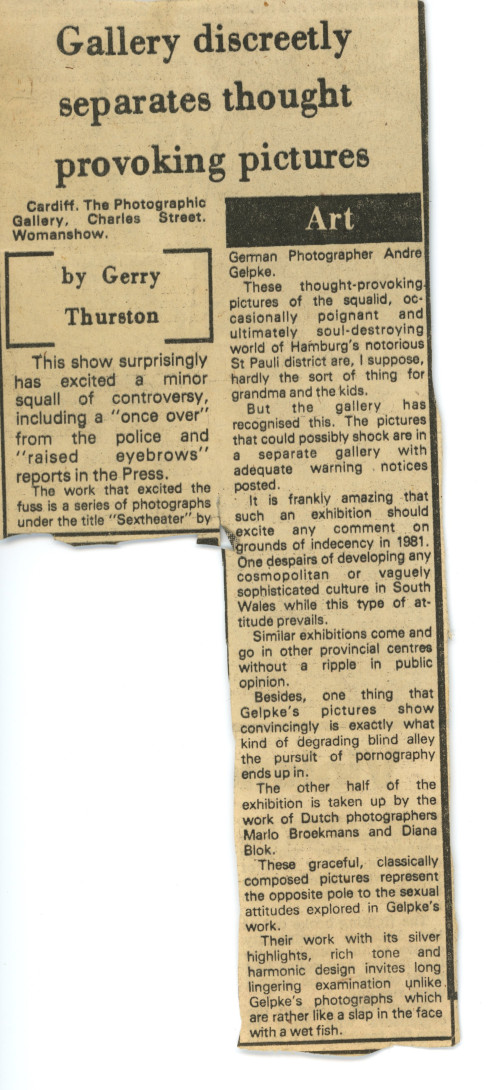
Press cutting (1) from Ffotogallery’s archive, featuring articles on ‘The Womenshow’, an exhibition held at Ffotogallery in 1981. Reproduction of copyrighted works is not permitted.
Press cutting (2) from Ffotogallery’s archive, featuring articles on ‘The Womenshow’, an exhibition held at Ffotogallery in 1981. Reproduction of copyrighted works is not permitted.
To think about Ffotogallery’s future, its impact on photography and the legacy for future generations it’s crucial to look back at the gallery’s past, how Ffotogallery came to exist and the journey taken to get to where we are today. We look back with a critical eye, photography and how society regards women has come a long way from where we were when Ffotogallery first existed in 1978, but the issues that present themselves in our archive are still relevant today. As an organisation, we are always working on new ways to challenge these issues and break barriers and provide opportunities for underrepresented artists.
In October 2024, we celebrated the first Ffoto Cymru: Wales International Festival of Photography which opened in venues across Wales. In a society where women artists and photographers are still regularly overlooked, the first Ffoto Cymru pointed the spotlight towards female photographers and artists using photography. With the theme What You See is What You Get? The festival questioned how we see, understand and use images and how they shape our identities and culture, from historical archives to AI and modern technologies.
At the centre of Ffoto Cymru was a major survey of work from the last 50 years by Marian Delyth showing at Ffotogallery in Cardiff. Titled Darnau | Fragments, it examined the profound impact of Delyth’s photographic journey over the past five decades, documenting Welsh life and culture, and featured activism, social justice, and peace campaigns in Wales and beyond. The intimate look at Delyth’s work, seeked to solidify her position as one of Wales’s most influential artists and celebrates her significant contributions to the artistic and visual identity of Wales.
The other associated venues presented newly commissioned work by four younger female Welsh or Wales-based photographic artists – Ada Marino, Adéọlá, Holly Davey and Jessie Edwards-Thomas, who used archives from galleries and museums around Wales to inform their commissioned pieces . Finally, a collaboration with the Foto Féminas network (which provides a platform to increase the visibility of Latin American and Caribbean female/non-binary photographers) showcases work by Luiza Possamai Kons from Brazil and Julieta Anaut from Argentina and Lorena Marchetti, also from Argentina.
Our archive collection consists of Ffotogallery’s exhibition prints, artist books, marketing and promotional materials and press cuttings – from 1978 to the present day, we are always adding new items to our collections with each new exhibition.
As we continue to explore our collection and uncover new information about our past, we look forward to digisiting these materials and sharing our findings with you.
The archive is open Wednesday – Friday from 11.00am – 4.00pm, by appointment only. To arrange a visit please email [email protected].
Bethlem Museum of the Mind is dedicated to using the historic collections of the South London and Maudsley NHS Foundation Trust to display and discuss issues in mental health, and to celebrate the achievements of people dealing with severe mental health issues.
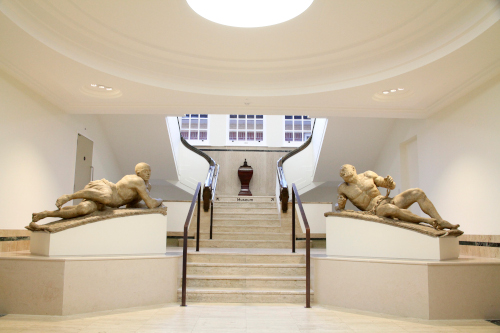
Raving and Melancholy (by Gaius Cibber, c.1676) in the atrium of the Museum.
The Museum is based in the former administration building of Bethlem Royal Hospital, today located in a 200 acre site in Beckenham, south London. Since 1948 the Hospital has been a specialist NHS psychiatric hospital, and today supplies 400 beds to the South London and Maudsley NHS Foundation Trust, which provides modern psychiatric care to those in need in the London Boroughs of Lambeth, Southwark, Lewisham and Croydon, as well as certain national services.
However, the Hospital has a past that stretches back over 750 years as Europe’s oldest specialist psychiatric hospital, across four different sites in London. Although there are many phases in Bethlem’s history, it’s early reputation for cruel treatment saw it christened ‘Bedlam’ by the Londoners living around it, and the entwining histories of the real place and the imagined place of chaos and confusion is something the Museum tries to unpick.
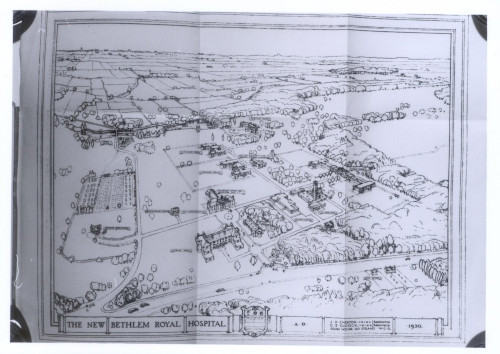
Drawing in black ink on white paper of hospital site and surrounding countryside.
The Museum of the Mind’s archive collections consist of the historic records of Bethlem Royal Hospital; The Maudsley Hospital, a specialist acute psychiatric hospital in south London which dates from 1923; and Warlingham Park Hospital, the Borough Asylum for Croydon, founded in 1903 and closed in 1999. These have been managed by a specialist archivist since the 1960s, and coexist in the Museum collections together with a collection of over 1000 artworks by patients, (viewable here), and more than 800 objects that reflect the history of the Trust.
The records for Bethlem date back to its incorporation as a civic charity in 1557 under the watchful eye of the Board of Governors of Bridewell and Bethlem Hospitals, a set of grandees drawn from the ranks of the City of London Corporation. The oldest set of records are the minutes of the Board of Governors, held under our reference BCB, and our oldest record of any patients of Bethlem is a rather unassuming list from 1598.
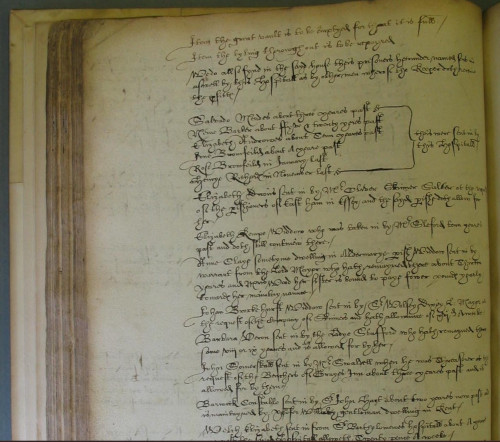
BCB-04, the first patient list from 4 December 1598.
As record keeping practices developed, one can see the emergence of something like a modern psychiatric hospital at Bethlem – admission records are created from the 1680s, and casebooks arrive in 1815. However all these records are in some ways problematic, as they express the patient experience through the lens of the Hospital, very often using out of date terminology and a contemporary attitude that seems woefully short of best practice today.
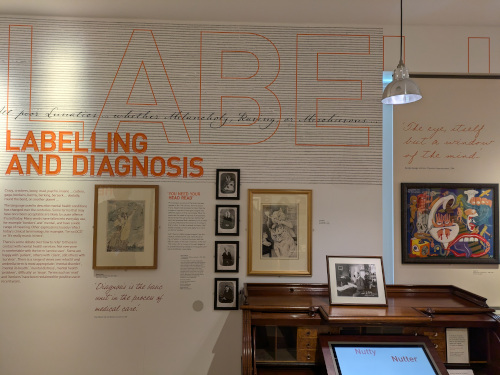
The Museum has therefore made the choice to try and address these shortcomings. One of the sections in the permanent displays looks at the limitations of language and medical jargon, especially around diagnosis. When the archives are used in the displays it is not done uncritically, but with an acknowledgement of the shortcomings of them as sources. Where we can, we have extracted the patient voice from smaller items in the casebooks, like letters and photographs, where a different, more personal, story can be found. The Museum also utilises the artwork it has collected to display, and celebrate, the voices of people with lived experience. Sometimes this voice directly clashes with the professional tone of the organisational record, but we believe that it is important to recognise a multiplicity of experience in this area. It’s also important to recognise that elements like ‘restraint’ (another section in the Museum) have both a past and a present in mental health treatment, and to speak of these issues as if they have vanished would be to hide a more complicated, if troubling, truth.
The ‘Labelling and Diagnosis’ section of the Museum.
The records in the archive cover 450 years of mental health treatment, and take up some 250 metres of shelving for plans, images, patient and staff records, as well as the committee records of the groups that administrated the hospitals. The records are catalogued to the Australian Series System, which is a little different to standard UK cataloguing practices, so what is on Archives Hub is really an indicator of what we hold rather than a comprehensive list – see the catalogue here.
In providing safe and professional storage and access the archivist fulfils the public records function for the NHS Trust, but also supports the displays of the Museum, the learning and outreach programme which spoke to over 3,000 students in 2023, and bespoke history projects like Change Minds, which worked with people with lived experience to investigate the lives of people who were treated in the Victorian Bethlem. We feel this work, in re-examining and investigating the lives of people who were in the hospital outside of the context of their mental health issues, to be amongst the most important things we do. You can see some of our blogs on this project here.
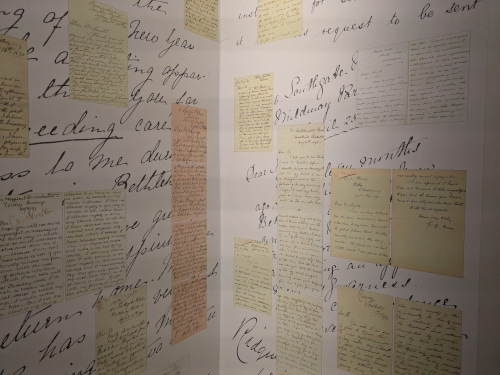
Letters taken from the casebook displayed in the Museum’s ‘Recovery’ section.
The Museum has put a wealth of historical resources online. The patient and staff records up to 1918 have been digitised and indexed on Find My Past and British Online Archives, allowing remote access to thousands of genealogists and academic researchers. The Museum has digitised some of its archives itself, most notably the Board of Governors Minute Books up to the 1800s, and the collection of Lantern slides of the Edward O’Donoghue, the Chaplain and first historian of the Hospital, which can be viewed via the catalogue under the series references BCB and LSC. There are also digital resources linked to the main website of the Museum, particularly in the ‘learning’ section, which deal with different times and hospitals: https://museumofthemind.org.uk/learning .
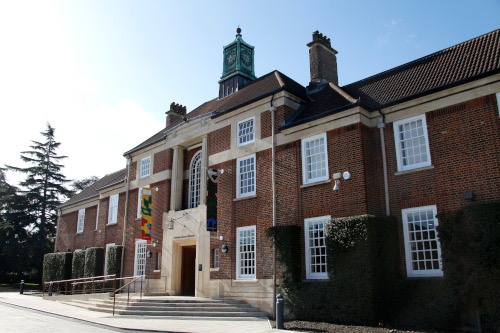
The Museum building onsite at Bethlem Royal Hospital.
The Museum is open Wednesday to Saturday 9.30am to 5.00pm without appointment and free to all visitors (last admission at 4.30pm). The archives are available by appointment with the archivist, potentially Monday to Friday 10am to 4.30pm. Our website covers all of this at https://museumofthemind.org.uk/ , and you can reach the archivist at https://museumofthemind.org.uk/contact (select ‘archives’ from the drop down menu).
David Luck, Archivist Bethlem Museum of the Mind Bethlem Royal Hospital
Dorset House School of Occupational Therapy, the first School of Occupational Therapy in the UK, opened on New Year’s Day 1930, but the inspiration for the School can be traced back to a festive morning in a hospital ward. Dr Elizabeth Casson (1881-1954), the School’s founder, was working in a psychiatric hospital when she realised the therapeutic benefits enjoyed by patients who were presented with tasks and activities rather than mere convalescence.
Find out how Christmas decoration making inspired the first School of Occupational Therapy in the UK!
As winter rolls in and Christmas looms around the corner, it’s fascinating to reflect on how nostalgia shapes this most memorable of seasons. When it comes to British festive traditions, one stands out more than most: pantomime.
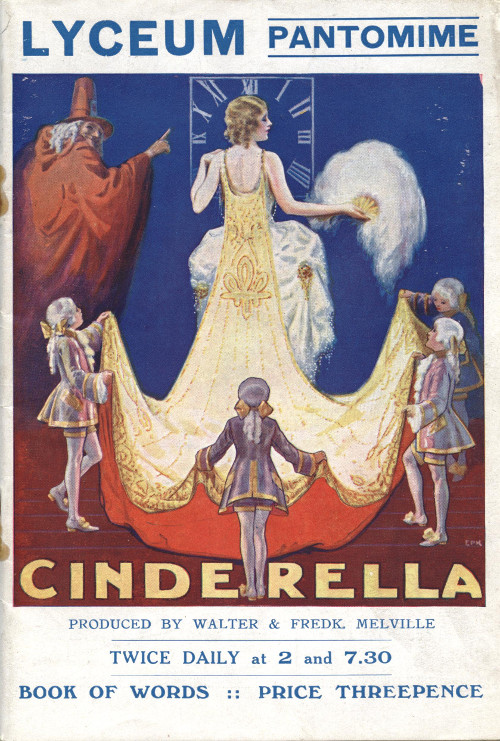
Pantomime is a uniquely British institution – it’s always fun trying to explain it to international friends! The University of Kent, celebrated the arrival of one of the largest collections of historic pantomime material in the UK: their David Drummond Pantomime Collection.
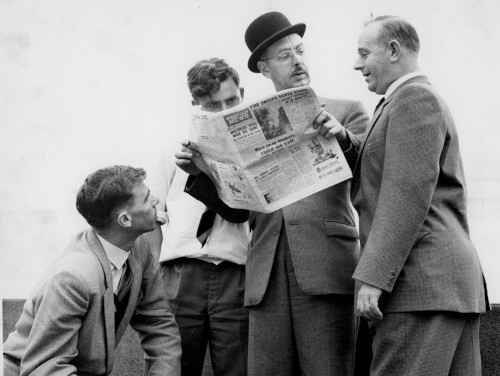
A group of men reading an issue of the Co-op News c1940 from the Co-operative Press photograph Collection.
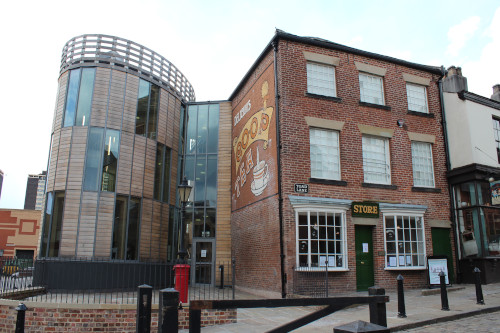
This year marks 180 years since the founding of Rochdale Equitable Pioneers Society – recognised as the first successful consumer retail co-operative. Toad Lane in Rochdale (now a museum) opened for business on the evening of 21st December, 1844. The society’s founding principles became the blueprint for the values and principles that define how the modern co-operative movement operate around the world today.
The Rochdale Equitable Pioneers Society
The 1840s were difficult times for working people: unemployment, short-term jobs and wage cuts, paired with increasing food prices led to poverty for many people. Food was often adulterated, for example, chalk was used to dilute flour, and tea was either re-used or contained other leaves.
In August of 1844, a group of 28 Rochdale workers met to form a co-operative society. Several of the Pioneers including Miles and Samuel Ashworth and William Cooper were flannel weavers and the majority came from Chartist or socialist backgrounds. They saw co-operation as the best way forward to give ordinary people control of their own organisation with all members having an equal share in the decision making and receiving a fair share of the profits. They named their co-operative ‘The Rochdale Society of Equitable Pioneers’ (REPS).
Theirs was not the first co-operative but they were the first to come up with a set of principles, to run one successfully for the benefit of the members and to establish a ‘co-op law’ to create solidarity in the movement. The ‘Rochdale Model’ became the foundation for other co-ops and through various mergers they became the Co-op Group, the biggest retail co-op in the UK.
Most people think a co-op is a grocery store, but there are many different types of co-ops working in every sector of the economy as well as providing grassroots solutions in communities. All co-ops are independent although are encouraged to work together as part of the wider movement.
Libraries and education
Education for members was at the heart of the co-operative movement. One of the original principles developed by REPS which remains with us today is that it offers education and training to everyone involved, so they can develop the co-op and promote the benefits of co-operation.
The exterior today of Rochdale Pioneers Museum on Toad Lane.
The Pioneers allocated a percentage of the profits towards education and took over the top floor of Toad Lane as a reading room and lecture hall. Most other co-ops had a room or a hall for learning and enjoyment. In 1867 REPS expanded to a Central Premises with dedicated library reading room and lecture theatre for 1500 members; it was just up the road from their first shop at Toad Lane.
The collections that we have at the Co-operative Heritage Trust cover the enormous history of the co-operative movement and include society business records, correspondence of Robert Owen and George Jacob Holyoake, photographs, advertising and education records, Women’s Guild collections and a large number of periodicals.
Some Examples from The Periodical Collection
The Periodical Collection spans from the early 1800s and continues to be added to today. There are periodicals from various societies, such as ‘The Herald’ from the Manchester and Salford Equitable Society, cultural magazines such as ‘Millgate Monthly’, periodicals for all co-op members, written for shop managers, college students and women’s guilds and we also hold all copies of the Co-op News first printed in 1871. The publications highlight issues and debates that were of import at the time of publication and aid the researcher to see trends and social changes both nationally and internationally. They contain information on the development of co-operative ideas within the labour movement.
Early Journals
The Archive holds a number of periodicals from the early-nineteenth century which demonstrate early ideas about co-operation and social reform. These include The Brighton Co-operator, which was edited by Dr William King, an early advocate of co-operation, as well as The Crisis, which was produced by Robert Owen. The collection also holds copies of The Reasoner, in which George Jacob Holyoake was involved.
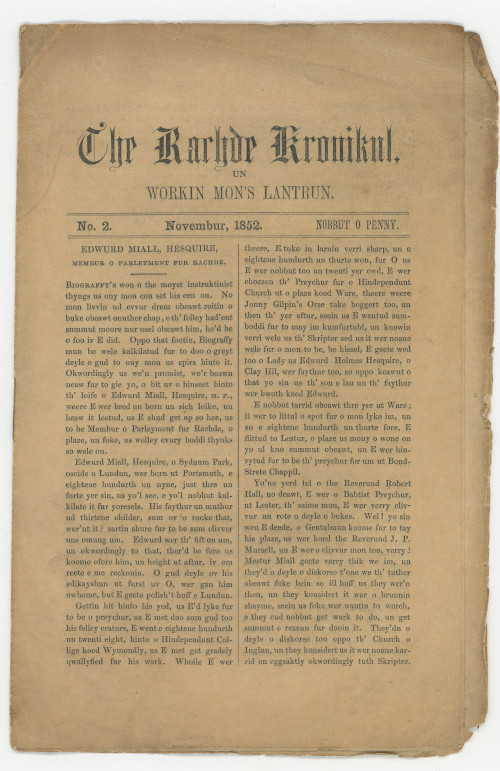
We also have copies of a short lived publication called ‘The Rachde Kronikul un Workin Mon’s Lantrun’ (The Rochdale Chronicle and Working Man’s Lantern) 1852 -1853. This was a short-lived publication from 1852-1853 produced by the Rochdale Co-operative Society and written in Rochdale dialect. This short-lived publication was produced to support independent journalism and raise the profile of co-operative and socialist content for working class communities.
It was available in the library of the Rochdale Equitable Pioneers Society, but accessible as intended to be read aloud at a time the movement were promoting equality of education for the masses. Other examples of dialect writing, such as Ethel Carnie Holdsworth’s work, can be found in copies of Wheatsheaf and the Co-op News.
First edition of ‘The Rachde Kronikul un Workin Mon’s Lantrun’ (The Rochdale Chronicle and Working Man’s Lantern), November 1852.
CWS Annuals
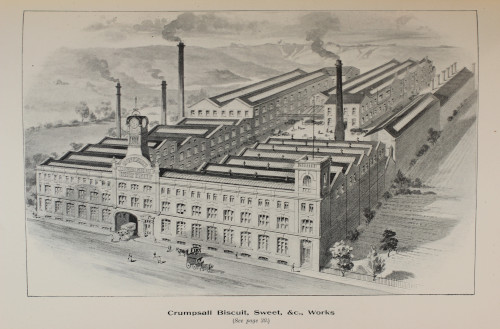
The CWS Annuals, published from the 1880s to 1960, gave information on the work of the Co-operative Wholesale Society and the Scottish Co-operative Wholesale Society. They contain trade figures and statistics as well as information on various factories and reports on the work of co-operative trade internationally. These Annuals are useful for research into trade figures, production and statistics of the CWS and SCWS and the early volumes include line drawings of the factories and other premises. They also included essays on trade and society outside the co-operative movement, by some of the foremost thinkers of the day.
An illustration of the Crumpsall biscuit factory from the CWS Annual, 1903.
The Producer
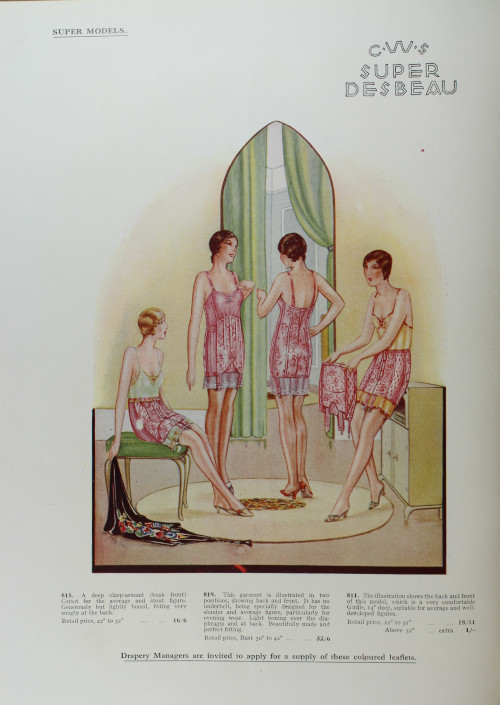
The Producer, which ran from 1916-1966, was a magazine for employees of co-operative societies. Its focus was on co-operative trade and products, with news from co-operative societies in the UK as well as internationally. There was also news on employees as well as features on window dressing and product display. The Producer is useful for news stories of co-operative societies, including productive co-operatives, as well as the international co-operative movement, and overseas trade. It also has articles on prominent individuals within the movement.
An advert from the 1930s in the ‘Producer’ for Desbeau Corsetry, 1930.
Millgate Monthly
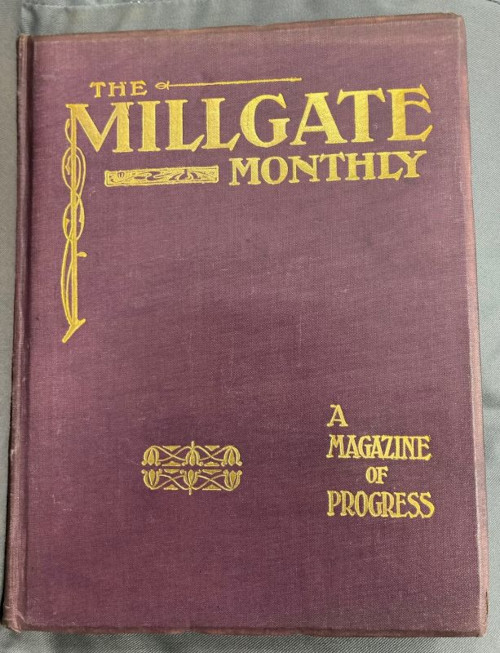
First published in 1905, the Millgate Monthly, sub-titled ‘A Magazine of Progress, was a cultural magazine containing articles written by co-operators on social issues, as well as articles on horticulture, short stories, poetry and reviews. It changed its name to simply The Millgate in 1928 and ceased publication in 1953.
The front cover of the Millage Monthly, 1914-1915 published in the Millgate area of Manchester by Co-op Press.
Women’s Outlook
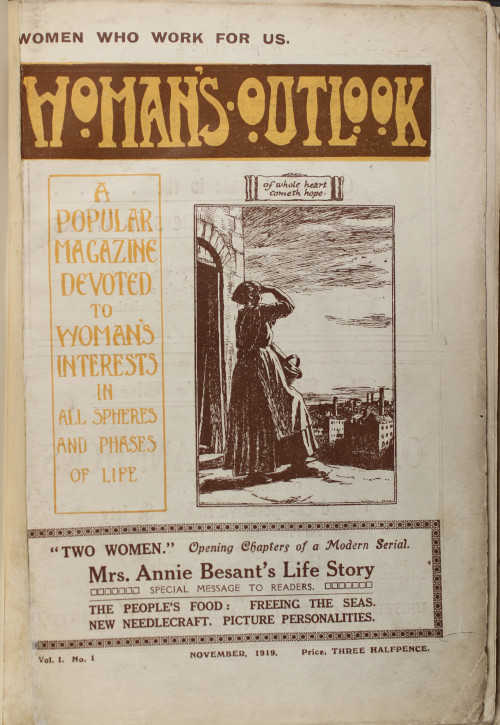
This is one of our most frequently requested records as it is a useful social and political history record of the modern period. It was the magazine of the Co-operative Women’s Guild and ran from 1919-1967. It focused on issues that were relevant to women such as gaining the vote, employment and maternity, highlighted the lives of women involved in political struggle alongside knitting patterns, short stories, household hints and recipes. Its editors included Mary Stott in the 1930s ‘40s and ‘50s, who went on to edit the women’s pages in the Guardian. It was international in its perspective and there were regular features on women and events across the globe.
The cover of the first Woman’s Outlook, November 1919.
Wheatsheaf
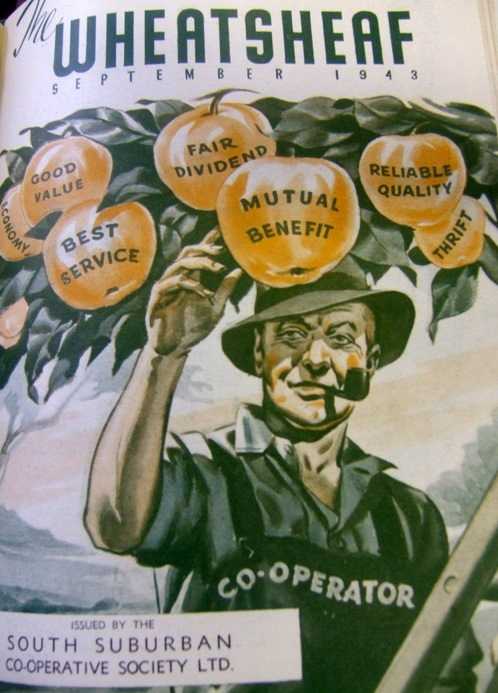
Published between 1896 and 1964, The Wheatsheaf was a monthly publication for members of co-operative societies and given away in stores. It was published by the Co-operative Wholesale Society and had a central section that was national, while the outside pages were published for individual consumer co-operatives and contained local news.
It contained short stories, household hints and reports of events within the co-operative movement. There were also pages specifically aimed at women and children. As mentioned previously, Ethel (Carnie) Holdsworth, a working class writer who had much of her work published in the journal.
In 1946, it was relaunched as The Co-operative Home Magazine, becoming just Home Magazine in January 1959. This was a monthly publication for members of co-operative societies.
The cover of Wheatsheaf magazine, September 1943.
Ourselves
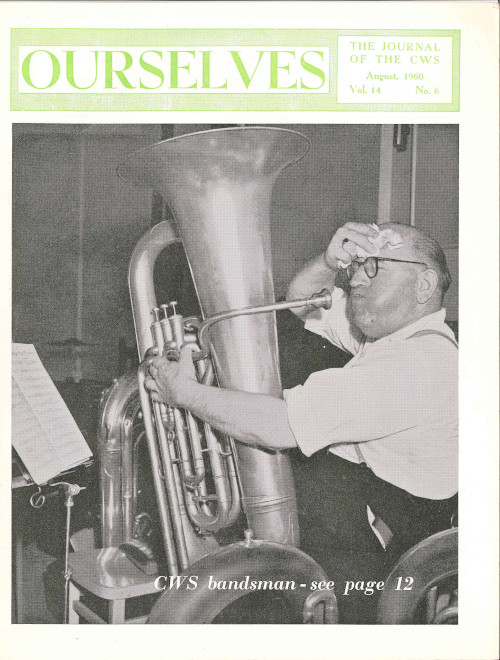
This was a journal for CWS employees featuring staff news various sport and social groups for staff and updates on stores developments. Staff wellbeing and sense of community can be seen in the pages of this periodical and is a great recorder of the culture of workers at the time.
Front cover of Ourselves, Aug 1960.
Co-op News
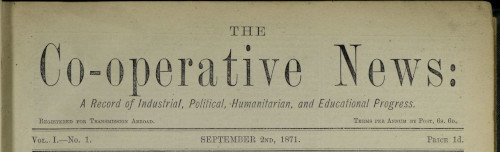
The Co-op News is now a monthly print and online news magazine and website about co-operatives around the world. First published in 1871 as The Co-operative News, it is the world’s oldest co-operative newspaper. It was published weekly when it began and was a means for co-operators to promote to the world their new ideas of cooperation.
The Co-operative Newspaper Society (later Co-operative Press) was formed in 1870 and registered as a co- operative, and the first national newspaper of the co-operative movement, called the Co-operative News and published weekly from September 1871 as “A Record of Industrial, Political, Humanitarian, and Educational Progress”.
The paper differed from other papers in that there were no adverts on the front page, a sign of a more radical publication. The earliest papers covered local news from societies, national news, international news and campaigns and propaganda, later having a Women’s Corner, a men’s corner, poetry and stories and letters to the editor. It later became more political with the formation of the Co-op Party and the allegiance to the Labour Party.
The newspaper was available in stores, by subscriptions and in many of the libraries that the societies had for the education of their members. The newspaper is still published monthly as an online and print paper today and is one of our most used resources in the reading room.
Front page of the Co-op News from September 2nd, 1871.
Details of all our periodicals can be found on Archives Hub.
Jane Donaldson, Archivist The National Co-operative Archive, Manchester Co-operative Heritage Trust
Visitors to University of Surrey Archives and Special Collections are sometimes surprised to discover that we hold much by the way of a historic institutional archive: surely as one of the new universities of the post-war era, built on a greenfield site in the Surrey Hills, our records can only go back so far? Yet although the University was established in 1966, its history dates back over half a century earlier, when it existed as the Battersea Polytechnic – and we are immensely fortunate to hold a rich and varied archive collection from this predecessor era.
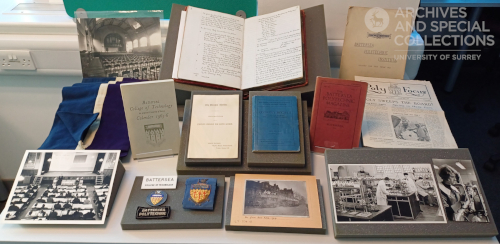
A display of items from the Battersea Polytechnic Archive.
The history of the Polytechnic dates to the late-nineteenth century. Founded in 1891 as the Battersea Polytechnic Institute, it was originally a very different sort of institution from a modern university. Trades-focused evening classes predominated the teaching offering, with few students studying for degree-level qualifications. There were even secondary schools run out of the Polytechnic during the daytime!
Over the course of the early twentieth century however, the proportion of students undertaking advanced study for University of London degrees steadily grew, and the Polytechnic gained a reputation for expertise on scientific and technical subjects. In 1956, the Polytechnic was recognised as a College of Advanced Technology, and it was renamed Battersea College of Technology the following year. The College continued to go from strength to strength, and following the 1963 Robbins Report – which called for the expansion of higher education in the United Kingdom – it was recommended that Battersea should become a new University in its own right.
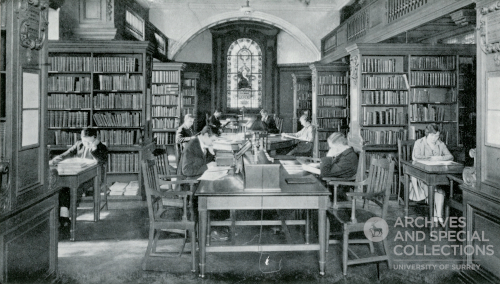
Students at work in the Edwin Tate Library at Battersea Polytechnic, 1920s (Ref No: BA/PH/2/7/2).
Our Battersea Collections
The Battersea Polytechnic Archive comprises original records and papers spanning the entire length of the institutions’ history. Key series within the archive include: formal records of the governing body; regular publications such as the Calendars (Prospectuses) and the Annual Reports of the Principal; records of Battersea Students’ Union, which offer a fantastic insight into student life at the Polytechnic; records relating to the foundation of the University of Surrey and the move to Guildford; and an extensive collection of photographs showcasing the history of the Polytechnic, its staff and students.
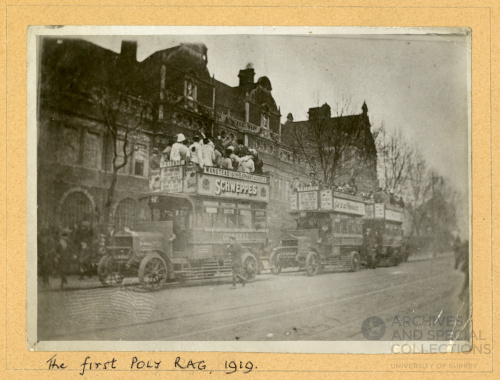
‘The first Poly Rag, 1919’ – this photograph of students on open-top buses is one of the earliest surviving references to Rag Week we hold in the archive. (Ref No: BA/PH/8/1).
In addition to the institutional archive, we also hold the Remembering Battersea Oral History Collection. This fantastic resource arose out of a project run by the University of Surrey between 2014 and 2016 with funding from the Heritage Lottery Fund, with the aim of recording and preserving the experiences of the last generations of Battersea students and staff from the 1940s, 1950s and 1960s. Comprising over 70 interviews, the collection provides wonderful insights into life at Battersea: from experiences of living in student digs to recollections of anarchic RAG Week activities, including the infamous Head of the Lake contest on Battersea Park Boating Lake.
Exploring the Polytechnic Archive
Our collections on Battersea Polytechnic are a great resource for studying the University’s past – but they also have a far greater research potential. The archive can be used for studying the history of education: for instance, publication series such as the Calendars provide a detailed overview of how academic disciplines and methods of study evolved over the early twentieth century.
Likewise, the Polytechnic’s records have much to offer for researchers looking at histories of youth and student culture: the meeting minutes and publications of the Students’ Union provide a fascinating insight into student perspectives and attitudes from different eras. Our oral history interviews also offer first-hand accounts of students’ experiences during the rapid social change of the post-war era: the recordings provide detailed accounts of students’ working and social lives, and how their experiences were shaped by attitudes towards gender and class.
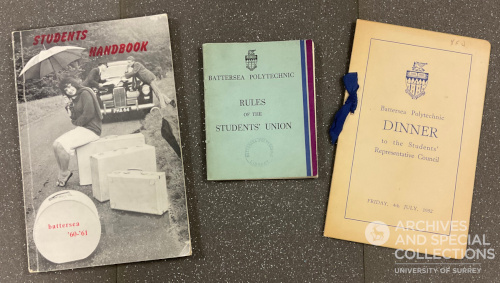
Three items from the records of the Battersea Students’ Union: the Union Handbook for new students, 1960/61 (Ref No: BA/G/3/1/4); the Rules of the Students’ Union, [1949], (Ref No: BA/G/1/1/2); and the menu card for a dinner in honour of the Students’ Representative Council, 1952 (BA/G/4/1/1).
The Battersea Polytechnic Archive is also surprisingly international in character: the sets of student registration cards from the middle of the century reveal a student population drawn from around the world. Reports of international events in the student magazines Polygon and Bat-Chat likewise suggest a student body proud of its international ties.
Of particular note are the records of the Polish University College. Established in the 1940s by the Polish Government in Exile, the Polish University College was an important base for many Polish academics and scientists opposed to the Soviet-backed post-war Polish government. The College was absorbed into Battersea Polytechnic in the early 1950s, and some of the records of this unique institution survive within the archive.
Discovering Battersea Stories
Working on the Polytechnic Archive, one is always struck by an awareness of all the individual stories of past students and staff contained within. We’ve worked with the University’s alumni team to support outreach events for Battersea graduates and their families, using our collections to help people reconnect with their memories of their student days. The archive is also a great resource for family history research, and we’re always happy to assist with genealogical enquiries.
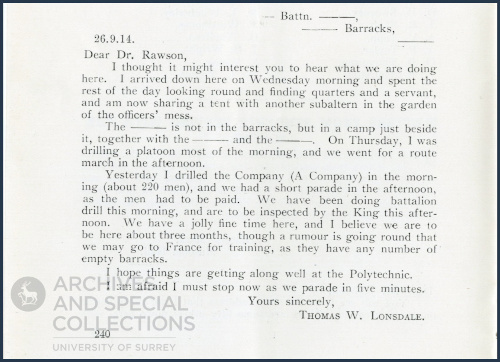
Perhaps nowhere is this sense of an archive of individual stories more striking than in the Polytechnic’s records from the First World War. Large numbers of Battersea students served in the conflict, and the pages of Battersea Polytechnic Magazine are filled with glimpses into their experiences: reports of action and bravery; letters sent back from those on the front (stripped of any information that might inadvertently help the enemy); and, sadly, lists of those who died in the fighting. These accounts provide a solemn but important record of the sacrifices made by the students of the Polytechnic, and we have used these stories from the archive to support the University’s Remembrance activities.
Letter from Battersea student Thomas W. Lonsdale to the Principal of the Polytechnic, Dr Rawson, as published in the Battersea Polytechnic Magazine, vol. 7, no. 37, Nov 1914 (Ref No: BA/G/3/2/2/7).
The University of Surrey is proud of its roots in Battersea, and in the Archives & Special Collections team we’re always on the look-out for ways to make our Battersea collections more accessible. Work is currently underway to improve access to the Battersea Polytechnic Archive, including making previously uncatalogued items available to the public for the first time. We also regularly take in donations of keepsakes and memorabilia from former students and their families, so that these incredibly important personal stories of Battersea are preserved for future generations.
Simon Mackley Archivist University of Surrey Archives & Special Collections