
“Gather them in” – the musical treasures of W.T. Freemantle

Archives Hub feature for February 2019

A new exhibition at the Treasures of the Brotherton Gallery at the University of Leeds explores the story of a forgotten Yorkshireman whose achievements are now being reassessed.

Dr Bryan White, Senior Lecturer in the School of Music at the University of Leeds, has been researching the material collected by the Sheffield-based organist, antiquarian and collector William Thomas Freemantle (1849-1931). Dr White’s investigations have revealed a tenacious collector who would “endure martyrdom in Siberia” to acquire unique treasures for his library.
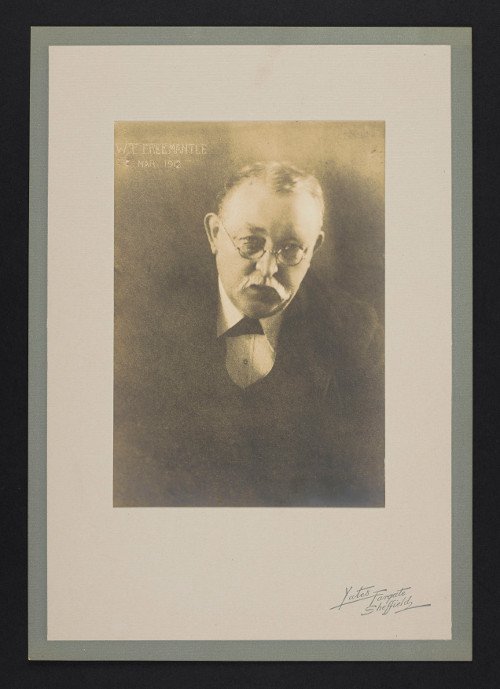
Photograph of W.T. Freemantle, 1912. Leeds University Library, Special Collections, MS 1700/6/7.

W.T. Freemantle’s musical interests extended widely and he gathered a valuable collection of manuscripts and prints. Much of this material has only recently been catalogued, and more still remains to be explored.

“W.T.” was born in Chichester and moved with his family to Sheffield in 1855. At the age of 16 he was apprenticed organist at Lincoln Cathedral and developed an interest in the music of Felix Mendelssohn (1809-1847).
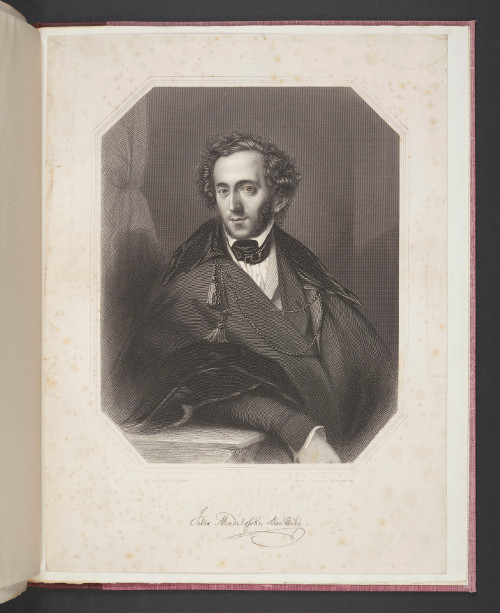
Engraving of Felix Mendelssohn Bartholdy made by A.H. Payne and W.C. Wrankmore, after a portrait by Theodore Hildebrand (c.1835). Leeds University Library, Special Collections, Brotherton Collection, uncatalogued holdings.

Freemantle’s enthusiasm for Mendelssohn ran against the tide. At the mid-point of the nineteenth century the composer was a towering figure in the musical landscape, particularly in Britain. Mendelssohn’s reputation waned in subsequent decades, but Freemantle continued to value his music highly. Today Mendelssohn is again one of the most popular Romantic composers, and Freemantle’s collection has much to offer the researcher.

Freemantle described his metamorphosis into a collector in a lecture entitled “How I became an autograph collector and what I have got”. He tells of a visit to a Sheffield market where he stumbled upon a “rather soiled looking lot of manuscript music”. As he worked through the pile he found a Mendelssohn signature and felt “my blood had heated, my pulse had quickened” … “Oh! That bundle of music! I was now indeed an autograph collector.”
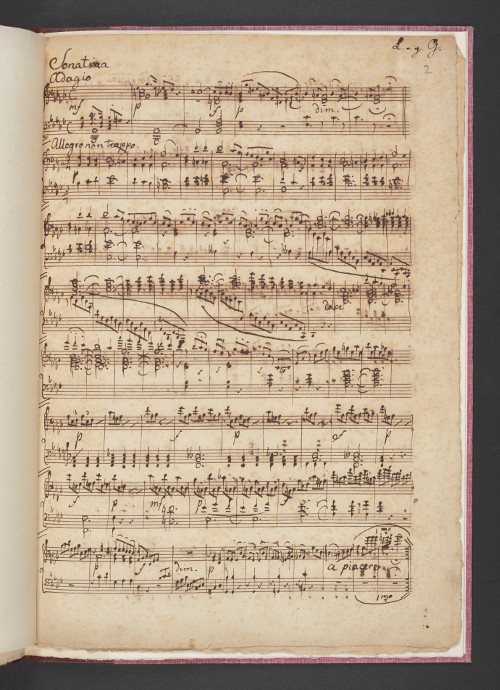
Autograph manuscript of Mendelssohn’s “Sonata” in B flat minor, 1823. This is the only source for this early sonata. Leeds University Library, Special Collections, BC MS Mendelssohn/Scores 1.

Several decades later his Mendelssohn collection encompassed 40 autograph manuscript scores, 300 letters, and hundreds of books, musical prints, concert programmes and other ephemera touching upon all aspects of the composer’s life and that of his family and colleagues. In the 1870s Freemantle began a biography of the composer, but eventually put the project aside when the extent of the surviving material overwhelmed him.
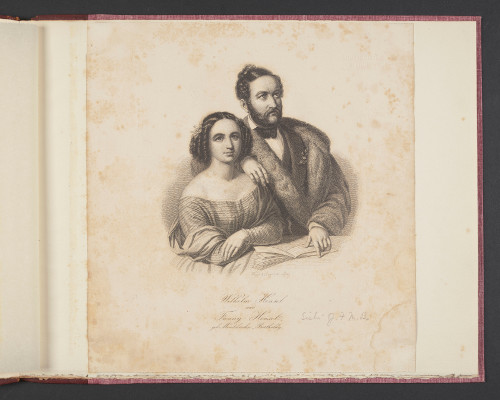
Engraving of Fanny Mendelssohn and her husband Wilhelm Hensel (August Weger and Johann-Paul Singer, 1846). Leeds University Library, Special Collections, Brotherton Collection, uncatalogued holdings.

Freemantle collected music by other significant figures, and in particular committed himself to the music of Charles Dibdin (1745-1814), a prolific composer of theatre music and songs. Freemantle acquired a substantial set of Dibdin’s autograph manuscripts, working with great skill and dedication to organise and identify this very disordered material.
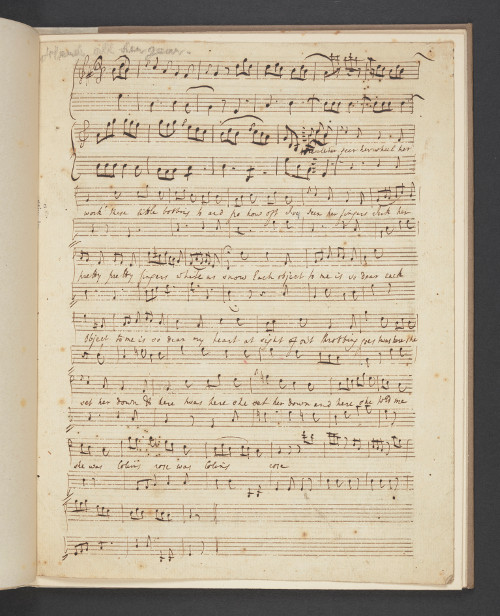
Charles Dibdin, autograph sketches of “Here’s all her gear” from his comic opera Rose and Colin, 1778. Leeds University Library, Special Collections, MS 1700/2/38.

W.T. also took a strong interest in Sheffield history. He acquired books, pottery, painting, prints and tokens from the local area and wrote and lectured on local history. His collection of Rockingham pottery was eventually bought by the Sheffield Corporation and now resides at Weston Park Museum along with his collection of coins and seals.

Freemantle sold his Mendelssohn collection along with his entire library to Lord Brotherton of Wakefield sometime in 1927-28. The purchase was probably brokered by Brotherton’s personal librarian, J. Alexander Symington (1887-1961). Symington had oversight of the Freemantle Collection before it was formally accessioned by the University Library in Leeds, and he took the opportunity to sell significant parts of the Mendelssohn and Dibdin material to libraries and collectors in the United States. His actions played a significant role in suppressing the extent of Freemantle’s activities and his reputation as a collector.
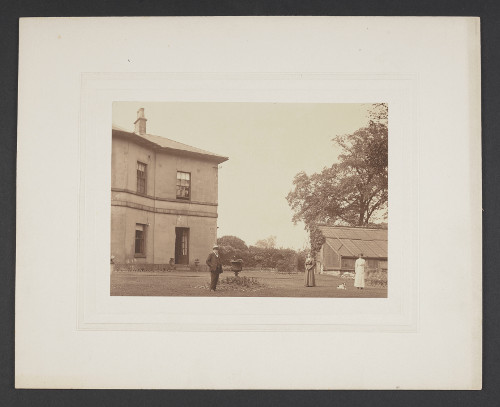
Photograph of W.T. Freemantle and family at Barbot Hall, 1913. Leeds University Library, Special Collections, Brotherton Collection, uncatalogued holdings.

Had Freemantle’s music collections remained intact he would be recognised as a pioneering figure in Mendelssohn studies, and more widely as a significant British collector of his era. Thankfully, the rest of Freemantle’s materials were left untouched and now form an important part of Special Collections at the University of Leeds. Now that Freemantle’s work is being reassessed, the real story of his achievements can begin to be told!

The exhibition runs from 1 March-31 July 2019 in the Treasures of the Brotherton Gallery at the University of Leeds.

On show for the first time to the general public are many of the Mendelssohn manuscript scores housed in Special Collections at Leeds University Library, alongside other items from Freemantle’s extensive music collections.

The Treasures of the Brotherton Gallery is free and open to all. For directions, opening times and our programme of related events see:

https://library.leeds.ac.uk/galleries

Get all the latest news and behind the scenes insights by following the Gallery on Facebook, Instagram and Twitter – @LULGalleries

Special Collections at Leeds University Library is home to hundreds of thousands of rare books, manuscripts, archives and artworks. Our collections offer a rich resource for staff, students, and the wider research community. Start your search here:

https://library.leeds.ac.uk/special-collections

Dr Bryan White
Senior Lecturer, School of Music, University of Leeds

Rhiannon Lawrence-Francis
Collections and Engagement Manager, Special Collections, University of Leeds

Related

Miscellaneous papers collected by W.T. Freemantle, ca.1775-ca.1925

Browse all University of Leeds Special Collections descriptions on the Archives Hub.

The Mendelssohn papers, mid-18th-19th century (held by the Bodleian Library, University of Oxford)

Previous features on the University of Leeds Special Collections:

Sentimental Journey: a focus on travel in the archives

Recipes through the ages 

World War One

All images copyright University of Leeds Special Collections and reproduced with the kind permission of the copyright holders.

Survey: Digital Skills in the Archives Sector


Do you work in the archives sector? What are your digital strengths? What digital support and training do you still need?

The National Archives and Jisc have created a survey to hear the latest thoughts of those working within (or who have a professional connection to) the sector on all aspects of their digital services and capabilities:

https://www.snapsurveys.com/wh/s.asp?k=154765868779

The results of this survey will directly inform The National Archives’ programme of work in support of the sector over the next 3-5 years. In collaboration with Jisc, The National Archives want to tackle various challenges at the intersection of archival practice and digital technologies, as well as to celebrate digital excellence in archives whenever possible.

The survey takes around 20-30 minutes to complete but not all questions are compulsory and many respondents will only need to answer certain applicable sections.

If you have any questions, please contact [email protected]. Thanks in advance for your help.

For those in peril on the sea – Seamen’s Missions archives at Hull History Centre

Archives Hub feature for January 2019

Over the past year, staff and volunteers at Hull University Archives have been working on the collections of two maritime charitable organisations: The Anglican run Missions to Seamen; and the Catholic run Apostleship of the Sea.

Photograph of an early ‘floating institute’ operated by the Missions to Seamen, late 19th century [U DMS].
Background to Seamen’s Missions

During the 18th and 19th centuries there was a growing concern over the spiritual wellbeing of those who spent their working lives at sea. First came the development of bible societies which existed to provide literature to sailors for their moral enrichment. Following on from this was the development of the seamen’s Bethels, which provided floating spaces where seamen could listen to sermons and take part in religious services.

The impetus for the establishment of both Missions to Seamen and Apostleship of the Sea can be found in the extension of this area to include concern with the physical welfare of seamen. Since their inception, the work of both organisations has been fundamentally the same: to minister, both spiritually and physically, to the needs of seafarers who find themselves away from home and family because of work.

The Missions to Seamen was founded in 1856 as a denominational society, Anglican in outlook. The first minute book of the society illustrates that the practice of ministering to seafarers was already active at the point of formation. Many of the pages, for instance, are taken up with discussions of how best to integrate existing local work, such as that undertaken by the Bristol Society established in 1837, with the newly formed national society.

The formation of the Apostleship of the Sea came later, in 1920, although the work of the Catholic Church in this area began much earlier. The Society of Saint Vincent de Paul had been undertaking charitable work on behalf of the poor, including seamen, since 1833. In 1894, the ‘Société des Oeuvres de Mer’ was established in France to tend to the needs of fishermen, and represented the first dedicated Catholic Mission. In Britain, five years later, a society was established at Glasgow under the name of the ‘Apostleship of Prayer’ by a Father Egger, again as a dedicated mission to those working on the sea. It was the work of this Glasgow society which eventually led to the papal sanctioning of the establishment of the Apostleship of the Sea as a Catholic society in Britain.

Ship Visiting and Seamens’ Centres

From the earliest days of their establishment, the undertaking of ship visiting by chaplains and the running of seamens’ centres in ports was at the heart of the work of both societies. The Missions to Seamen was known throughout the world by the sign of the ‘Flying Angel’, whilst the Apostleship of the Sea was known internationally as the ‘Apostolatus Maris’. For over a century, these symbols were displayed on badges worn by chaplains and on flags flown outside the centres operated by the two societies. The signs became immediately recognisable by seamen of all nationalities as symbols of aid.

Logo of the Flying Angel [U DMS].
Logo of the Stella Maris [U DAPS/12/4].
Chaplains were appointed by both societies to minister to seamen on ships entering individual ports. Where ships were docked and crew unable to alight, the chaplain had responsibility for visiting the crew on-board in order to deliver spiritual reading material and to check on their welfare. Bibles were provided and publications produced by both societies were handed out to seamen. Both collections contain series of these publications, which include newsletters, journals, prayer cards and pamphlets. Missions to Seamen also contains an extensive series of personnel files for chaplains and lay readers who undertook this aspect of work. The files consist mostly of correspondence, applications for posts, and some photographs of individuals about their work.

Photograph of the interior of the original Apostleship of the Sea house in Glasgow, c.1920s [U DAPS/7/2].
Seamen’s centres were established at significant ports up and down the British Isles and, later, across the world. They provided facilities for relaxation, refreshment, and spiritual nourishment, and were intended to provide for seamen needing a place to stay whilst in port, whether this was overnight or merely for a few hours. Facilities included games rooms, libraries, dining areas, and a shop. Most centres incorporated a chapel where services and prayers were held, or else were associated with a local church where such spiritual ministry could be sought. In some ports, these centres were operated jointly by both societies as a more efficient way of ministering to the seafaring community which they served.

Both collections contain series of individual port files which include reports, correspondence, photographs and pamphlets. Hull, as a significant port town during the 19th and early 20th century, features heavily in the archival material, as does Southampton and Bristol, along with ports on the rivers Thames, Mersey, Tyne, Wear, and Tees. Internationally, Antwerp, Buenos Aires, Dunkirk, Hamburg, Hong Kong, Kobe, Mombasa, Port of Spain, Rotterdam, Santos, Vlissingen, and Yokohama, are well represented in the records.

Lighthouses, Lightships and Launches

The work of both Missions to Seamen and Apostleship of the Sea extended beyond those sailing on board ships to include those maritime workers who faced months of isolation manning lighthouses and lightships. Launches were acquired to enable chaplains and representatives of the societies to visit these remote workers. The launches were used to deliver reading material and personnel to allow the holding of services at lighthouses or on-board lightships. One such launch was the ‘John Ashley’ motor vessel. Operated by the Missions to Seamen, it was named after the Reverend John Ashley, an Anglican clergyman responsible for the establishment of the Bristol Mission in 1837. A significant number of files relating to the management and operation of the ‘John Ashley’ can be found in the Missions to Seamen collection, and these files include correspondence, photographs and minutes of the management committee.

Photograph of a visit paid to Bishop Rock lighthouse by Missions to Seamen representatives for the Scilly Isles [U DMS].
Photograph of a visit paid to Bishop Rock lighthouse by Missions to Seamen
representatives for the Scilly Isles [U DMS].
In the 1920s, a ‘Lighthouse Adoption Scheme’ was established by Missions to Seamen, whereby groups attached to local schools or parish churches were encouraged to take on responsibility for writing to and sending monthly reading material to lighthouse keepers. These groups were known as ‘parents’, and had special duties at Christmas time when they would raise money to send hampers and care packages containing food and warm clothing. One such group was constituted from members of the Guild of St Anne in 1925 to oversee efforts at Bishop Rock lighthouse in the Scilly Isles. Over the years, members of the Bishop Rock ‘parent’ group included Miss Jean Austin Dobson, Miss Ivy Shotter, and Miss D. Hobson. The collection contains Lighthouse and Light Vessel files consisting of correspondence, photographs, reports and minutes, and includes one file which contains correspondence between the Bishop Rock ‘Parents’ and headquarters in London.

Ongoing Work

The work of both societies continues to this day, largely unchanged, although increasingly incorporating themes of justice and legal rights for seamen. Meanwhile, work on these historic records continues at Hull History Centre. Whilst the records of the Apostleship of the Sea have been fully catalogued [U DAPS], work is ongoing to complete the cataloguing of the records of the Missions to Seamen [U DMS]. This work is expected to be finished by August 2019, however, access may be possible before then with prior notice by email.

Claire Weatherall
Assistant Archivist
Hull University Archives at Hull History Centre

Related

Records of Apostleship of the Sea, 1922-2014

Browse all Hull History Centre collections on the Archives Hub.

All images copyright Hull History Centre and reproduced with the kind permission of the copyright holders.